
Planning Cabin Assignments: How to Avoid Chaos on Tournament Day
16 teams, 4 locker rooms, one morning—and right in the middle of it all, the question: “Where should we get changed?” A well-planned locker room assignment is one of the most underrated factors for success at tournaments. In this guide, we’ll show you how to plan locker room assignments professionally and avoid common stressful situations.
Why cabin occupancy matters
In small tournaments with 4–6 teams, the issue of locker rooms often resolves itself. But as soon as there are more teams than there are locker rooms, planning becomes essential. Proper locker room allocation ensures:
- Smooth workflow:Teamsknow immediately where they need to go—no delays caused by searching or waiting.
- Fairness:Allteams have the same conditions and enough time to change clothes.
- Professionalism:Aclear schedule shows that someone has put some thought into it.
- Less stress: As the organizer,youdon't have to constantly answer questions or resolve conflicts.
Common problems without planning
If you leave cabin assignments up to chance, you often end up in the following situations:
The Cabin Chaos
Two teams are standing in front of the same locker room at the same time. One has just finished a game; the other has to take the field in five minutes. Hectic, frustrating, and delayed.
The Never-Ending Cast
One team occupies "its" locker room the whole time, even though it only has three games. Other teams have to change in the hallway or wait.
The Problem with Valuables
Team A leaves their bags in the locker room. Team B changes there. Later, something is reportedly missing. An awkward situation for everyone.
The Forgotten Girls' Team
There is one girls' team among 15 boys' teams. No one thought to assign them a separate locker room.
At an indoor tournament with 12 teams and only two available locker rooms, there was a 20-minute delay because there was no clear assignment of the rooms. The final had to be shortened to ensure the venue closed on time.
The 5 Basic Rules of Cabin Design
1. Rotation system instead of fixed assignments
If there are more teams than changing rooms, fixed assignments won't work. Instead, changing rooms are assigned on a rotating basis according to the schedule. Team A uses Changing Room 1 before Game 1, after which Team B moves into Changing Room 1.
2. Allow for some extra time
There should be at least 10–15 minutes between two bookings for the same room. This gives the first group time to clear out and prevents overlap.
3. Synchronize the game schedule and locker room assignments
The locker room schedule must align with the game schedule. If Team A plays at 10:00 a.m., it must have access to the locker room starting at 9:45 a.m.—not just starting at 9:55 a.m.
4. Separate sections for special cases
Girls' and women's teams, referees, and, if applicable, visiting teams from farther away often require separate or priority locker rooms.
5. Communicate the policy on valuables
Make it clear: Valuables do not belong in the locker room, or are left there at your own risk. Alternatively: Provide a secure area or lockers.
Creating a Cabin Seating Chart: Step by Step
Now we're getting down to business. With these instructions, you can create your cabin layout systematically and avoid common mistakes.
Take stock
How many cabins are available? How big are they (how many people can fit inside)? Are there showers? Are all the cabins the same, or are there "better" and "worse" ones?
Categorize teams
List all participating teams. Note any special cases: girls' teams, teams traveling from far away, and the host team (which may not need a locker room).
Define a time window
Take a look at the schedule. When is each team playing? So when will they need a locker room? Create time slots (e.g., 9:00–9:30, 9:30–10:00, etc.).
Make an assignment
For each time slot, note which team is using which room. Be sure to leave some buffer time between bookings.
Check for conflicts
Check: Are there any scheduling conflicts? Does each team have enough time before its game? Have special cases been taken into account?
View and share the plan
Create a clear overview (table or chart). Post the plan and share it digitally with the teams.
Example: Visual cabin seating chart
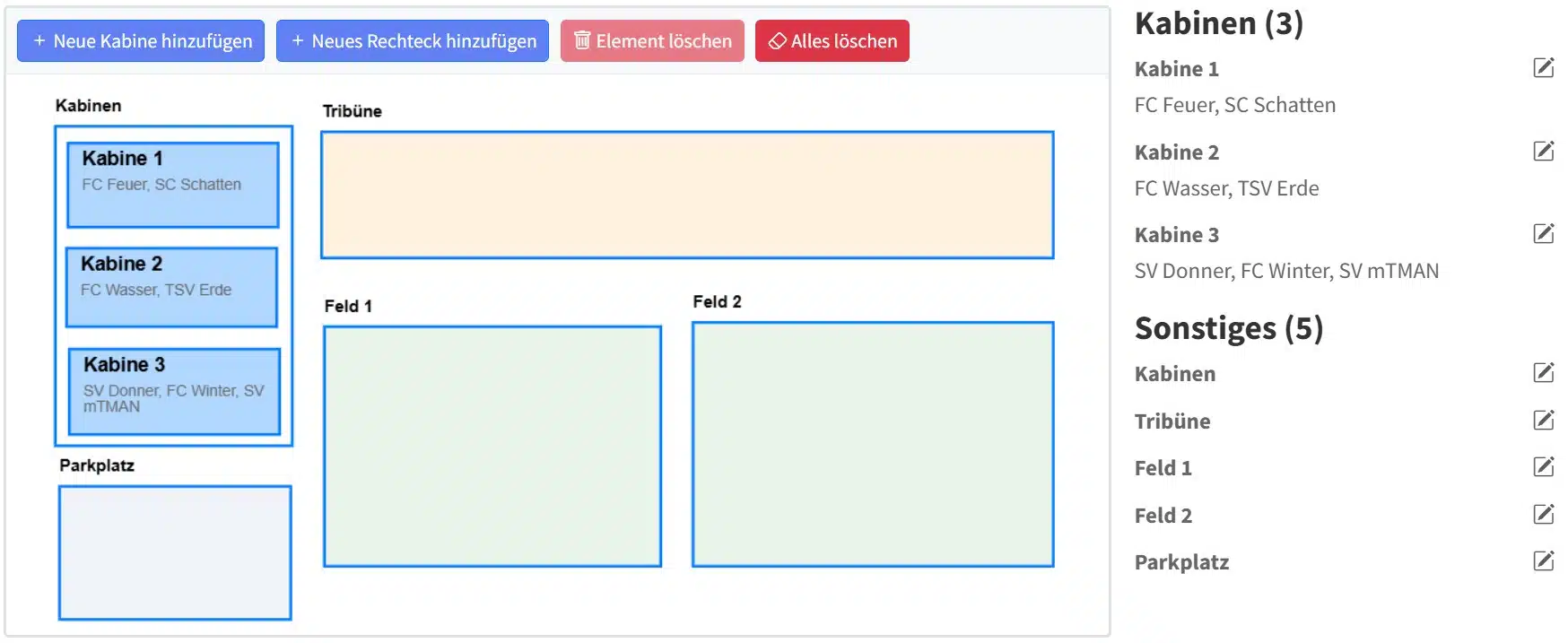
Locker rooms and seating chart in the myTMAN tournament software
myTMAN Cabin & Seating Planner
With myTMAN's visual seating planner, you can create your cabin layout using drag-and-drop. You can:
- Create locker rooms, playing fields, parking lots, and other facilities
- Assign teams with a single click
- Export the plan as a PDF and print it
- View the schedule directly on the tournament invitation page
This way, registered teams can see which locker room has been assigned to them even before the tournament begins.
Special Cases: Girls, Referees, and Others
Girls' and women's teams
In mixed tournaments, a separate locker room must be reserved for girls' teams. Ideally, this should not be rotated but permanently assigned. If there are only a few locker rooms available, schedule time slots so that there is no overlap with boys' teams.
Referee
Referees also need a changing area—ideally their own small room or at least a reserved time slot. For indoor tournaments with multiple referees: Reserve a room exclusively for referees.
Visiting teams with a long journey
Teams traveling from farther away often arrive already dressed or need more time before their first game. Keep this in mind when planning and assign them an early time slot.
Host Team
The host team often has access to its own facilities (clubhouse, separate locker room). This locker room does not need to be included in the schedule for visiting teams.
Communicate the plan
Even the best seating chart is useless if no one knows about it. Here’s how to make sure everyone is informed:
- Before the tournament: Sendthe locker room assignment listalong with the schedule to all teams (via email or on the tournament invitation page).
- On the day of the tournament: Postthe schedulein a clearly visible location in the entrance area—preferably laminated and in color.
- Label the booth doors: Attachsignsto the booths with team names and time slots.
- Brief the volunteers:At leastone volunteer should be familiar with the seating chart and be able to answer questions.
Create a QR code that links to the digital locker room map. Post it in the entrance area. This way, coaches can save the map to their phones and check it anytime.
Checklist for Competition Day
- All cabins are clean and in good condition
- The cabin schedule is posted (at the entrance and in each cabin)
- The cabin doors are labeled
- Separate changing room reserved for girls/women
- Referee's room prepared
- Volunteers have been informed about the seating chart
- QR code for the digital map available
- Policy on Valuables Communicated
- Backup cabin / Contingency plan for emergencies
- First-aid station clearly marked and signposted
Conclusion: Plan ahead for a stress-free tournament
Planning your cabin assignments carefully isn't rocket science, but it makes a big difference. With a clear plan, you can avoid stress, delays, and awkward situations. The time you invest will pay off many times over on tournament day—for you as the organizer and for all participants.
Key points summarized
✅ Plan cabin occupancy early—don’t leave it to chance
✅ Rotation system when there are more teams than locker rooms
✅Allow for a buffer period between bookings (10–15 min)
✅ Take special cases into account: girls, referees, visitors
✅ Visualize the plan, post it, and share it digitally
✅ Label the cabin doors and brief the volunteers
✅ Easily create a schedule with tools like myTMAN
Visually plan cabin seating
With the myTMAN seating planner, you can create your cabin layout using drag-and-drop—including PDF export and display on the invitation page.